
José María Ruano de la Haza, 2026
In the dynamic cultural world of seventeenth-century Spain, theatrical performances were not confined to the teatros comerciales (corrales and casas de comedias, coliseos, patios de hospitales, etc.). The plays of Lope de Vega, Tirso de Molina, and Calderón de la Barca also circulated in a remarkably democratic print form: the sueltas, low-cost, unbound printings of a single play. Typically comprising two or more folded sheets of cheap paper, sueltas were sold for a few maravedís by booksellers and printers.
Unlike the prestigious Partes (collected volumes of twelve plays each, often authorized by or attributed to a single dramatist), sueltas were printed quickly, and without pretension. Printers in Madrid, Seville, Valencia, and Barcelona issued them in large quantities, frequently without the playwright’s involvement or consent. Attribution was casual at best and fraudulent at worst: plays were regularly misattributed, and popular names — most notably Lope de Vega, whose output was so vast that almost anything, including Calderón’s La vida es sueño,1 could plausibly be attributed to him — were invoked freely to boost sales.
These ephemeral editions, especially the early ones, often lacked explicit imprint information, making bibliographical identification challenging. Their large numbers suggest that public appetite for individual plays extended far beyond elite circles. The economics were those of disposability. Sueltas were not intended to be preserved in libraries; they were meant to be read,2 possibly performed in domestic or amateur settings, passed between friends, and eventually lost. Survival was accidental. Many sueltas exist today in only a single known copy; others may have vanished entirely, only to become inferred links in the branches of a stemma. As textual witnesses, however, they may reveal textual variants, stage directions, or transmission features which can illuminate practices of staging and production.
Sueltas served multiple purposes. A reader might wish to study the verse of a celebrated poet, or simply enjoy reading drama as literature — a practice far more prevalent in seventeenth century Europe than we often assume. Additionally, there is evidence that sueltas fed back into theatrical practice. Second- and third-tier acting companies touring smaller towns and villages, without access to manuscript copies or the means to purchase them, might rely on printed sueltas as performance texts, even when those texts were corrupted or abridged. In his article “Comedias sueltas: an Introduction”, included in this webpage, Don Cruickshank states that he found some sueltas bearing descriptions such as “fácil de executar en cualquier casa, para cinco hombres solos”; and “pieza militar en tres actos, fácil de executar en casas particulares, por estar arreglada para siete hombres solos”. The printed and performed versions of Spanish seventeenth-century plays were thus engaged in constant dialogue.
During the eighteenth and nineteenth centuries, prominent collectors—such as Lord Holland, Agustín Durán, and the bibliographer Cayetano Alberto de la Barrera—amassed numerous sueltas. These collections are now housed in the British Library, the Biblioteca Nacional de España, and the Hispanic Society Museum & Library.3 More recently, digital projects, notably comediassueltasusa.org and ISTAE (Impresos sueltos del teatro antiguo español), have made a substantial number of bibliographical descriptions of sueltas, together with images of their first and last pages, available online, rendering what was once an exercise in archival pilgrimage into something approaching comprehensive access.4 When preparing my own edition of Calderón’s Cada uno para sí in 1972-1974, I was able to locate only four sueltas.5 As a comprehensive census, comediassueltasusa.org lists 43, including several entries that are duplicates or triplicates.
1See Don W. Cruickshank’s article “Comedias sueltas: an Introduction” in the Essays section of comediassueltasusa.org.
2 According to Alan Paterson, a suelta of Calderón’s El pintor de su deshonra, preserved in the Library of the British Museum, contains a text to be read, whilst a manuscript of the same play in the Biblioteca Nacional of Madrid “se aproxima a la autenticidad de la representación”. See Alan K. G. Paterson, “El texto original: ¿realidad o ensueño? Un caso típico: El pintor de su deshonra, de Calderón”. Teatros y vida teatral en el Siglo de Oro a través de las fuentes documentales. Ed. Luciano García Lorenzo and John E. Varey (London: Tamesis, 1991), p. 294.
3Another remarkable, and still little known, collection of Spanish books, including many sueltas bound into factitious volumes, is that preserved at the Municipal Library of Albi. The entire collection was bequeathed to the city by naval officer, politician and scholar Henri-Pascal de Rochegude (1741–1834).
4See also Kurt and Roswitha Reichenberger, Bibliographische Handbuch der Calderón Forschung (Kassel: Thiele and Schwarz, 1981) and my review in Segismundo, 35-36 (1982), pp. 262-65.
5See my critical edition published in Kassel: Edition Reichenberger, 1982.
1. Text
For editors and textual scholars, sueltas are both a headache and a treasure. As they were set from whatever copy lay at hand — a reliable manuscript, another printed edition, or what appears to be a memorial reconstruction6 — their texts vary wildly in quality. This variability is further compounded by evidence suggesting that some of them may have been dictated to the compositor. Consequently, a suelta might preserve an authentic early reading lost from all other sources, or it might be riddled with compositorial errors, or both. In either case, it may prove valuable in tracing the line of transmission of a playtext.
The stage directions of a suelta frequently mirrored the performance of a particular company. Playwrights, aware that they lacked control over their texts after selling them, typically refrained from writing elaborate stage directions. Consequently, the additional stage directions inserted by individual autores (actor-managers) on their manuscript copies were often reproduced in sueltas and can prove useful in establishing a stemma.
A case in point is the opening stage direction of Calderón’s La vida es sueño. The extant witnesses of the first version indicate that Rosaura “sale en hábito de hombre, como que ha caído“, while those of the second version state that she “Sale en lo alto de un monte”. Notably, all the extant witnesses of the first version omit this mention of the monte. However, this does not necessarily imply that Calderón himself had excluded this popular set piece from his original text. In fact, the addition of the phrase “como que ha caído” in the first version suggests that his original stage direction might not have been significantly different from that of the second version. It does indicate, however, that a particular autor had decided to eliminate the monte, which is hardly essential for the staging of the play. Regardless of the explanation, this variant swiftly and effectively aids in assigning extant witnesses to one of the two versions of La vida es sueño. A complementary example of the same phenomenon can be found in Calderón’s El príncipe constante: the manuscript edited by Alberto Porqueras Mayo (Ms. 15.159 of the Biblioteca Nacional in Madrid) was evidently revised by an autor whose interventions — deletions, marginal additions, altered cues — are distinctly distinguishable from the authorial layer of the text.7
These observations point to a deeper methodological question: what precisely is the relationship between the work of the textual critic and that of the theatre historian? At first sight they appear to be parallel activities, independent of one another. The textual critic seeks to restore, as far as possible, the text that comes closest to the playwright’s last intentions; the theatre historian seeks to reconstruct the original production. But if we consider that the theatre historian cannot restore the original staging of a comedia without a reliable text, and that the textual critic must grapple with whether the text to be edited is the one the playwright originally wrote or the one the audience actually saw and heard — that is, the staged version — we begin to glimpse a connection between the two activities.
Stage directions are often invaluable in establishing not only the affiliation of a suelta but also the transmission of a playtext: different textual families will reflect different stagings of the same play. The qualification is important, however: what the stage directions illuminate is the transmission of the play, not necessarily its text as the poet conceived it. The poet’s stage directions are on many occasions nothing more than proposals or suggestions, which the autor had every right to modify and adapt in practice.
It is worth pausing on a related bibliographical point. Sometimes the deletions, alterations, and additions that autores made to the poet’s stage directions were reflected back in the autograph manuscript; but in most cases the changes were made in working copies — sometimes partial copies — used by the actors to learn their lines, or as a prompter’s text. The original manuscript was kept more or less intact in the chest that formed part of the company’s hato.8 This explains why, unlike what happened with Shakespeare’s plays, a relatively large number of autographs of Spanish seventeenth-century playwrights have survived more or less in the state in which they were first handed over. These autograph versions do not necessarily reflect what contemporary audiences actually saw on stage, since the changes and additions made by the autores would have been recorded in the prompter’s manuscript and in partial copies, later appearing in sueltas derived from them.
The additional stage directions frequently found in sueltas thus serve a dual purpose: they facilitate the grouping of extant witnesses into textual families, and they may provide information regarding the provenance and transmission of the play. This information is invaluable in determining what type of text a critic wants or can edit. This in turn raises a pointed editorial question. If, as is the case with Sebastián de Alarcón’s manuscript copy of Calderón’s El postrer duelo de España, evidence surfaces that the dramatist approved the stage and textual changes made by an autor after the delivery of their original manuscript,9 should we prioritize the poet’s autograph—if it has survived—over the copy that incorporates those later, authorially sanctioned revisions?
While stage directions in sueltas may prove useful for establishing a stemma, the same cannot be said of their punctuation. Punctuation varied significantly from printing house to printing house and from scribe to scribe, rendering it of no practical use to the textual critic. Some scholars categorize such variants under “Accidentals”,10 but in my opinion, as far as Spanish sueltas are concerned, they are valueless.
Finally, it is crucial to learn how to describe a suelta in bibliographical terms precise enough to distinguish it from all other sueltas. In this regard, Edward M. Wilson’s 1973 article “Comedias sueltas: A bibliographical problem” is still unsurpassed.11
6See my articles “An Early Rehash of Peribáñez.” Bulletin of the Comediantes, 35 (1983), pp. 5-29 and “La relación textual entre El burlador de Sevilla y Tan largo me lo fiáis.” Tirso de Molina: del siglo de oro al siglo XX. Ed. Ignacio Arellano et al. (Madrid: Revista Estudios 1995), pp. 283-95.
7See Pedro Calderón de la Barca, El príncipe constante. Ed. Alberto Porqueras Mayo (Madrid, Espasa-Calpe, 1975).
8There is no single English term for hato. The nearest approximation would be something like “the company’s stock (of properties, apparel, and playbooks)”.
9 See “Two seventeenth-century scribes of Calderón.” Modern Language Review, 73 (1978), pp. 71-81.
10See W. W. Greg, “The Rationale of Copy-Text”, Studies in Bibliography, 3 (1950-51), pp. 19-36.
11See Pedro Calderón de la Barca, Comedias, a facsimile edition prepared by D. W. Cruickshank and J. E. Varey. Vol. I. Edward M. Wilson and Don W. Cruickshank, The Textual Criticism of Calderón’s Comedias (Gregg International and Tamesis Books, 1973), pp. 211-219. Szilvia Szmuk-Tanenbaum reminds me that D. W. Cruickshank illustrated this claim with his article in the essay section of this website, “Four Editions of Cada uno para sí: A Bibliographic Challenge”. In 2016, he wrote how seemingly identical imprints can vary in ways that words cannot define. It was the advent of the internet that introduced the solution for accurate descriptions by making it possible to include images to online bibliographic records.
2. Space
Sueltas were printed between 1600 and 1850, which means that many of them continued to be published for more than a century after the demise of the corrales. However, to understand sueltas fully, we must attempt to place them within the performance spaces for which the plays they reproduce were originally conceived.
The most common site was the corral de comedias, an open-air courtyard theatre that emerged in the late sixteenth century and became the dominant secular performance space of the Golden Age. A corral was typically a rectangular courtyard bounded by houses, with a raised stage at one end.12 Audience placement was socially structured: the wealthy occupied balconies and windows overlooking the yard; civil servants and clergy viewed the performance from the top-tier desvanes (at least in the Madrid corrales); women watched from the cazuela (“stewpot”); and common male spectators (the mosqueteros) gathered in the central patio, some seated on benches, others standing. These spaces were not merely architectural stages but social theatres where all classes encountered dramatic culture together.
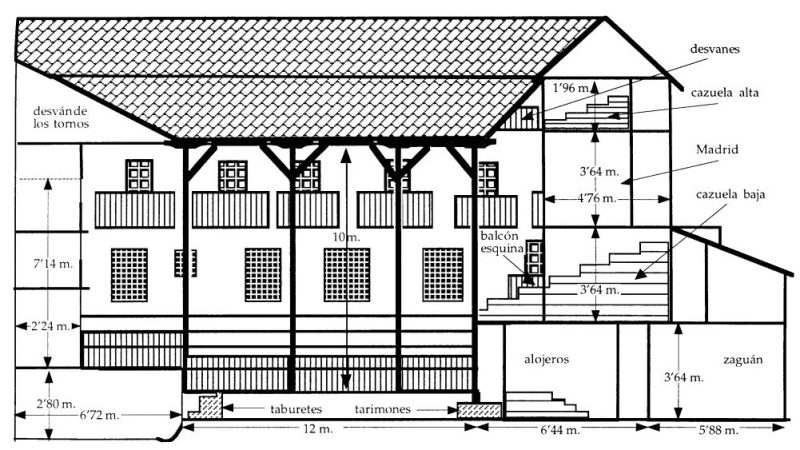
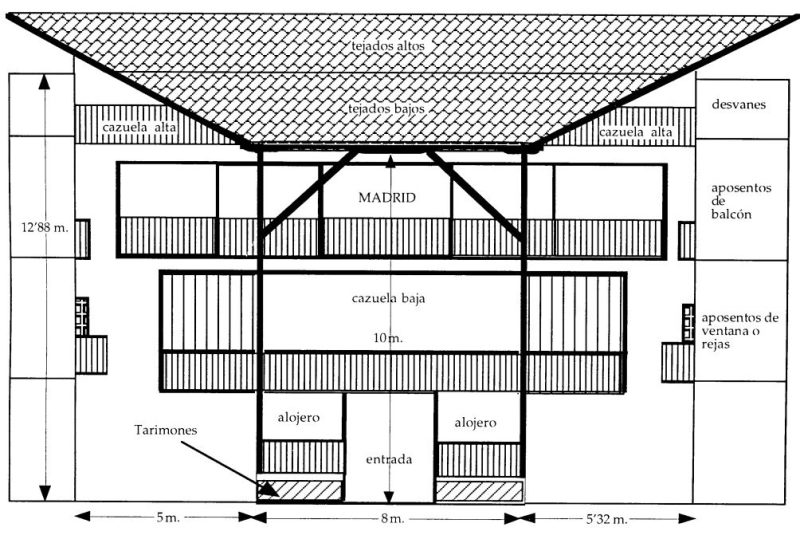
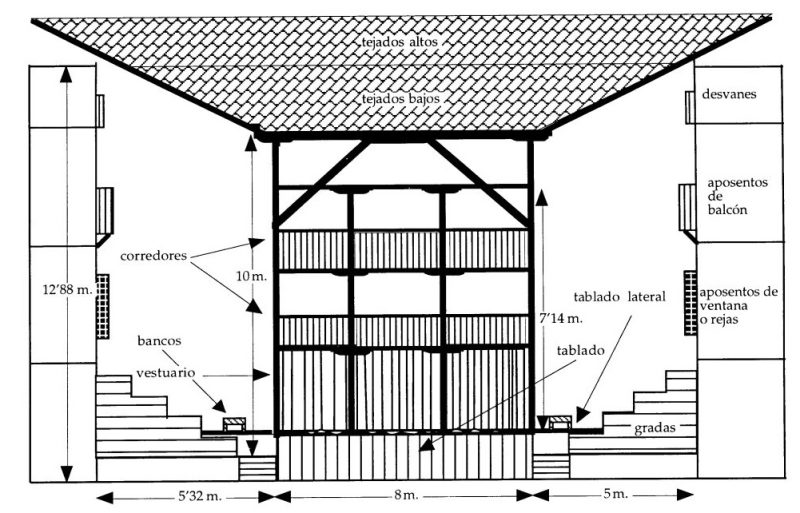
Illus. 1-3. José M. Ruano de la Haza, “Los corrales comedias de Madrid en el siglo XVII”. Corrales y Coliseos en la Península Ibérica. Edited by José María Díez Borque. Cuadernos de Teatro Clásico, no. 6 (Madrid: Compañía de Teatro Clásico, 1991), pp. 65-67. See end of the article for a translation of the labels on these illustrations.
It is important to bear in mind, however, that there is not and never will be a single way to stage a play, as each production and performance is unique. This uniqueness stems from various factors, such as the composition of the company, the intended audience, and the specific venue. While there may have been limited variation among the handful of performances a company gave when it premiered a play in Madrid, once it embarked on a tour through the towns, villages and cities of seventeenth-century Spain, adaptations became unavoidable. In Almagro, it could not be done the same way as in Madrid; nor in Toledo as in Seville; nor in Córdoba as in Pamplona; nor in Valencia as in Guadalajara — because each of these performance spaces was different.13 This is the primary reason for the scarcity of stage directions that, as we observed earlier, are typically found in autographs or copies close to the playwright’s original.
While corrales were the commercial hub of Spanish theatre, plays were also performed in other, more restricted settings. Comedias privadas were staged in palace salones, convent courtyards, university halls, and private aristocratic residences. Nobles frequently hosted performances during seasonal festivities, where the intimate setting influenced dramaturgy and audience expectations differed from those in public corrales. A related, but not identical category, the comedias de encargo (commissioned plays) could incorporate elaborate scenography, music, dance, and stage machinery that would have been impossible or uneconomical in a commercial playhouse. Plays performed in such contexts were often tied to specific occasions, such as weddings, diplomatic visits, and seasonal festivities. Some sueltas preserve evidence of this milieu through dedications, prefatory verses, or references to noble patrons. While the printed text does not always specify a venue, such paratextual framing helps to reconstruct networks of patronage and suggest that certain sueltas may have circulated initially within restricted or courtly circles before entering the broader print market.
A striking example is Tirso de Molina’s Pizarro Trilogy (see the sueltas in this website)14, almost certainly commissioned by the Pizarro descendants. We do not know where or how the plays were performed, or even if they were performed at all—it is possible that they were intended to be read. The elaborate stage directions — verging on the kind one associates with court theatre, even if technically realizable in simpler form in a corral stage — and the number of characters required—between 25 and 35 in each play—suggest that the trilogy was meant to be performed, like many autos sacramentales and some comedias de encargo, by two companies in a specific space with stage facilities beyond those available in a typical corral de comedias. The sueltas of the Pizarro Trilogy provide a useful illustration of how a private commission could generate a textual tradition quite distinct from the commercially circulated sueltas of the same period.15
University towns such as Salamanca and Alcalá hosted performances by students and faculty, especially during feast days. Convents and religious communities also staged dramatic productions. Surviving sueltas occasionally contain manuscript annotations, such as ownership marks, marginal cues, or performance cuts, which suggest practical use in such settings. These annotations provide valuable evidence of the life of the printed text beyond the bookseller’s stall. A suelta bearing rehearsal marks, distribution of roles, or underlined speeches likely functioned as a working script. Cataloguing such evidence enriches the historical record by distinguishing pristine collector copies from texts visibly embedded in performance practice.
These diverse performance spaces help explain which plays gained currency in manuscript and print, and whether comedias were collected in Partes or issued as sueltas. The short, focused format of a typical suelta reflects the way plays functioned within a larger programme of entertainments. Audiences expected variety, which meant any given play was experienced as a self-contained unit rather than part of a larger whole; publishers responded to that habit by producing single-play prints, since that was precisely the unit audiences wanted to own. Sporadic references to performance spaces embedded in suelta titles underscore the close connection between text and stage in the public imagination.
12See J. M. Ruano de la Haza and John J. Allen, Los teatros comerciales del siglo XVII y la escenificación de la Comedia. Nueva Biblioteca de Erudición y Crítica, No. 8 (Madrid: Editorial Castalia, 1994) and Manuel Canseco’s computer-generated images of the Corral del Príncipe in the Appendix to my book La puesta en escena en los teatros comerciales de Siglo de Oro (Madrid: Castalia, 2000).
13 See John J. Allen’s Chapter VI, “Otros teatros comerciales”, Ibid. pp. 197-231.
14See also La «Trilogía de los Pizarros» de Tirso de Molina. Estudio crítico. Ed. Miguel Zugasti (Kassel, Reichenberger, 1993).
15Szilvia Szmuk-Tanenbaum informs me that “Whenever possible, the bibliographic records in comediassueltasusa.org include these elements in ‘Local Notes’, as well as provide detailed images of internal pages.”
3. Performance
In his El día de fiesta por la tarde, Zabaleta describes a male spectator so eager for a seat that he would rather pick a quarrel to secure a bench than endure standing for the three hours the spectacle lasted.16 Three hours seems about right when we consider that a typical performance consisted of not only a three-act play but also a loa, one or two entremeses, a dance, and a fin de fiesta. As far as can be ascertained, there was no intermission between acts and the ancillary pieces.17
Some sueltas preserve the comedia, a loa, and one or two entremeses within the same printing. A documented instance of the comedia-plus-loa format is the 1611 Valencia suelta of La famosa comedia de la vida y muerte del glorioso y bienaventurado padre San Francisco, attributed to Lope de Vega and printed by Juan Vicente Franco, which carries at its front Agustín de Rojas’s loa titled Las cuatro edades del mundo. A more elaborate example of the composite format—comedia plus loa plus entremeses, with the short pieces interspersed between the acts of the play—is provided by a Viennese imprint: TRIVNFOS DEL DICIEMBRE. “En Viena: en la emprenta de Mateo Cosmerovio impresor de corte, año de 1668”. Its contents are organized as follows: 1) Loa en música (pages 11-20); 2) Comedia famosa Darlo todo y no dar nada (by Calderón), Act I (pages 21-74); 3) Los alcaldes entremés famoso, primera parte (pages 75-88); 4) Act II (pages 89-148); 5) Los alcaldes entremés famoso, segunda parte (pages 149-160); Act III (pages 161-221).18 This composite structure mirrors precisely the sequence of a live performance. The occasional printing of a comedia alongside a loa or entremés is not a mere bibliographic coincidence; it faithfully reproduces theatrical practice in print form.
Stage directions that illuminate actual performances abound in the sueltas. For example, a suelta of Luis de Belmonte’s El diablo predicador contains references to a escotillón (trapdoor) on the stage, which is, of course, the entrance to Hell: “Sale Asmodeo por un escotillón” (fol. A1r); and an elaborate description of a tramoya: “Baja en la tramoya que mejor parezca una niña que haga la Virgen, acompañada de ángeles, y llega hasta Octavia [who is on stage] y tócala con las manos.” (fol. D1r). A suelta of Lope de Vega’s La fianza satisfecha incorporates stage directions more elaborate than Lope usually wrote: “sale Leonido con la espada sangrienta en la mano” (fol. A1v) and “dale [Leonido a Gerardo] con la daga en los ojos y llevará Gerardo un lienzo con sangre” (fol. C1v). A suelta of Felipe Godínez’s Las lágrimas de David describes what is probably a tableau vivant: “descúbrese una huerta hecha de yedra a una parte del tablado, y en ella se ve a Zabulona y damas con azafates desnudando a Bersabé” (fol. A4v).19
As noted above, stage directions of this kind may reflect the interventions of an autor, the playwright’s own revisions, or both; in either case, they survive in sueltas in ways that autographs rarely preserve.
The commercial vitality of the corrales also explains the sheer number of surviving sueltas. Plays required partial scripts for actors, copies for prompters, and printed versions for readers eager to revisit what they had seen on stage. Reprinting was common; variant title pages and differing imprint information in otherwise similar sueltas often reflect sustained public demand rather than textual revision. A title that remained in heavy rotation at these venues often shows up in multiple suelta printings from different printers and different regions — variants are bibliographically valuable because they help establish impressions, reprints, and regional print centres.20
16Juan de Zabaleta, El día de fiesta por la tarde en Madrid (Madrid: Imprenta de Juan de San Martín, 1754), pp. 5-6 (fol. A3v).
17Szilvia Szmuk-Tanenbaum tells me that “As a page within RESOURCES, Comediassueltasusa.org created a Table: ‘Comedias Printed with Short Theatrical Works’ to document these occurrences from within its database.”
18 Both sueltas are included in the Database of comediassueltasusa.org.
19All three sueltas are included in the Database of comediassueltasusa.org. For more examples, see my La puesta en escena en los teatros comerciales de Siglo de Oro (Madrid: Castalia, 2000).
20Szilvia Szmuk-Tanenbaum adds that “Regarding comparison of variants, it is interesting to note the Orga practice of concealed reprints. Once their stock of popular sueltas printed originally in the 1760s and 1770s sold out, the Orgas got busy in the early 1780s reprinting the same titles with identical setting of movable type (including the colophons) to the original ones. These concealed reprints were designed to avoid having to pay a reprint license fee, and even with the use of short s and slightly different ornaments at the end of the rope design evident in the later printings, they were able to deceive the authorities — there are no records of court cases against them.”
* * *
In conclusion, sueltas are not merely marginal curiosities but integral components of a performance-aware history of Spanish Golden Age theatre. Their inexpensive print format and broad distribution reflect the popular theatrical culture of the corrales and other performance venues. They sit at the intersection of theatre history, bibliography, and material culture. When we move beyond seeing them solely as textual artifacts and contextualize them within the performance environments for which they were conceived, we gain insight into their printing practices, their use and how to catalogue them accurately.
Incorporating performance-related metadata in bibliographical records enhances the utility of sueltas for both librarians and scholars. Relevant fields include: performance venue (inferred or documented); associated ancillary texts (loa, sainete, entremés, or baile); physical evidence of use (annotations, ownership marks); and print variant groupings (same title, different printers or locations). When cataloguers record such data, end users can discern not just a title’s textual existence but the performance cultures in which it circulated. The comediassueltasusa.org’s and ISTAE’s photographic documentation and bibliographical data facilitate this in a way that was previously unavailable to most researchers.
Sueltas are elements of a vibrant theatrical ecosystem in which print and performance were mutually reinforcing. The urban corral, the palace hall, the university aula, and the convent courtyard each left subtle imprints on the format, framing, and survival of sueltas. To read a suelta without reference to performance is to read only half the document. Its typography and paper tell one story; the spaces in which its words once resonated tell another. Together they reveal a theatrical culture in which drama thrived simultaneously on stage and in print — modular, mobile, and deeply embedded in the social fabric of early modern Spain.
Translations of labels for Illustrations 1–3
- desván de los tornos = heavens (or shadow)
- desvanes = attic boxes
- cazuela alta = upper stewpan (women’s box)
- Madrid = Madrid councillors’ box
- cazuela baja = lower stewpan (women’s box)
- balcón esquina = corner balcony box
- alojeros = refreshment shops
- zaguán = entrance passage
- tarimones = risers
- taburetes = stools
- tejados altos = upper roof
- tejados bajos = lower roof
- desvanes = attic boxes
- cazuela alta = upper stewpan
- aposentos de balcón = balcony boxes
- Madrid = Madrid councillors’ box
- cazuela baja = lower stewpan
- aposentos de ventana o rejas = window boxes or barred windows
- tarimones = risers
- alojero = refreshment shop
- entrada = entrance passage
- tejados altos = upper roof
- tejados bajos = lower roof
- desvanes = attic boxes
- aposentos de balcón = balcony boxes
- aposentos de ventana o rejas = window boxes or barred windows
- corredores = upper stage levels
- tablado = stage platform
- tablado lateral = side platform
- vestuario = tiring house
- bancos = benches
- gradas = degrees (tiered benches)
3. Performance
In his El día de fiesta por la tarde, Zabaleta describes a male spectator so eager for a seat that he would rather pick a quarrel to secure a bench than endure standing for the three hours the spectacle lasted.16 Three hours seems about right when we consider that a typical performance consisted of not only a three-act play but also a loa, one or two entremeses, a dance, and a fin de fiesta. As far as can be ascertained, there was no intermission between acts and the ancillary pieces.17
Some sueltas preserve the comedia, a loa, and one or two entremeses within the same printing. A documented instance of the comedia-plus-loa format is the 1611 Valencia suelta of La famosa comedia de la vida y muerte del glorioso y bienaventurado padre San Francisco, attributed to Lope de Vega and printed by Juan Vicente Franco, which carries at its front Agustín de Rojas’s loa titled Las cuatro edades del mundo. A more elaborate example of the composite format—comedia plus loa plus entremeses, with the short pieces interspersed between the acts of the play—is provided by a Viennese imprint: TRIVNFOS DEL DICIEMBRE. “En Viena: en la emprenta de Mateo Cosmerovio impresor de corte, año de 1668”. Its contents are organized as follows: 1) Loa en música (pages 11-20); 2) Comedia famosa Darlo todo y no dar nada (by Calderón), Act I (pages 21-74); 3) Los alcaldes entremés famoso, primera parte (pages 75-88); 4) Act II (pages 89-148); 5) Los alcaldes entremés famoso, segunda parte (pages 149-160); Act III (pages 161-221).18 This composite structure mirrors precisely the sequence of a live performance. The occasional printing of a comedia alongside a loa or entremés is not a mere bibliographic coincidence; it faithfully reproduces theatrical practice in print form.
Stage directions that illuminate actual performances abound in the sueltas. For example, a suelta of Luis de Belmonte’s El diablo predicador contains references to a escotillón (trapdoor) on the stage, which is, of course, the entrance to Hell: “Sale Asmodeo por un escotillón” (fol. A1r); and an elaborate description of a tramoya: “Baja en la tramoya que mejor parezca una niña que haga la Virgen, acompañada de ángeles, y llega hasta Octavia [who is on stage] y tócala con las manos.” (fol. D1r). A suelta of Lope de Vega’s La fianza satisfecha incorporates stage directions more elaborate than Lope usually wrote: “sale Leonido con la espada sangrienta en la mano” (fol. A1v) and “dale [Leonido a Gerardo] con la daga en los ojos y llevará Gerardo un lienzo con sangre” (fol. C1v). A suelta of Felipe Godínez’s Las lágrimas de David describes what is probably a tableau vivant: “descúbrese una huerta hecha de yedra a una parte del tablado, y en ella se ve a Zabulona y damas con azafates desnudando a Bersabé” (fol. A4v).19
As noted above, stage directions of this kind may reflect the interventions of an autor, the playwright’s own revisions, or both; in either case, they survive in sueltas in ways that autographs rarely preserve.
The commercial vitality of the corrales also explains the sheer number of surviving sueltas. Plays required partial scripts for actors, copies for prompters, and printed versions for readers eager to revisit what they had seen on stage. Reprinting was common; variant title pages and differing imprint information in otherwise similar sueltas often reflect sustained public demand rather than textual revision. A title that remained in heavy rotation at these venues often shows up in multiple suelta printings from different printers and different regions — variants are bibliographically valuable because they help establish impressions, reprints, and regional print centres.20
16Juan de Zabaleta, El día de fiesta por la tarde en Madrid (Madrid: Imprenta de Juan de San Martín, 1754), pp. 5-6 (fol. A3v).
17Szilvia Szmuk-Tanenbaum tells me that “As a page within RESOURCES, Comediassueltasusa.org created a Table: ‘Comedias Printed with Short Theatrical Works’ to document these occurrences from within its database.”
18 Both sueltas are included in the Database of comediassueltasusa.org.
19All three sueltas are included in the Database of comediassueltasusa.org. For more examples, see my La puesta en escena en los teatros comerciales de Siglo de Oro (Madrid: Castalia, 2000).
20Szilvia Szmuk-Tanenbaum adds that “Regarding comparison of variants, it is interesting to note the Orga practice of concealed reprints. Once their stock of popular sueltas printed originally in the 1760s and 1770s sold out, the Orgas got busy in the early 1780s reprinting the same titles with identical setting of movable type (including the colophons) to the original ones. These concealed reprints were designed to avoid having to pay a reprint license fee, and even with the use of short s and slightly different ornaments at the end of the rope design evident in the later printings, they were able to deceive the authorities — there are no records of court cases against them.”
In conclusion, sueltas are not merely marginal curiosities but integral components of a performance-aware history of Spanish Golden Age theatre. Their inexpensive print format and broad distribution reflect the popular theatrical culture of the corrales and other performance venues. They sit at the intersection of theatre history, bibliography, and material culture. When we move beyond seeing them solely as textual artifacts and contextualize them within the performance environments for which they were conceived, we gain insight into their printing practices, their use and how to catalogue them accurately.
Incorporating performance-related metadata in bibliographical records enhances the utility of sueltas for both librarians and scholars. Relevant fields include: performance venue (inferred or documented); associated ancillary texts (loa, sainete, entremés, or baile); physical evidence of use (annotations, ownership marks); and print variant groupings (same title, different printers or locations). When cataloguers record such data, end users can discern not just a title’s textual existence but the performance cultures in which it circulated. The comediassueltasusa.org’s and ISTAE’s photographic documentation and bibliographical data facilitate this in a way that was previously unavailable to most researchers.
Sueltas are elements of a vibrant theatrical ecosystem in which print and performance were mutually reinforcing. The urban corral, the palace hall, the university aula, and the convent courtyard each left subtle imprints on the format, framing, and survival of sueltas. To read a suelta without reference to performance is to read only half the document. Its typography and paper tell one story; the spaces in which its words once resonated tell another. Together they reveal a theatrical culture in which drama thrived simultaneously on stage and in print — modular, mobile, and deeply embedded in the social fabric of early modern Spain.
Translations of labels for Illustrations 1–3
- desván de los tornos = heavens (or shadow)
- desvanes = attic boxes
- cazuela alta = upper stewpan (women’s box)
- Madrid = Madrid councillors’ box
- cazuela baja = lower stewpan (women’s box)
- balcón esquina = corner balcony box
- alojeros = refreshment shops
- zaguán = entrance passage
- tarimones = risers
- taburetes = stools
- tejados altos = upper roof
- tejados bajos = lower roof
- desvanes = attic boxes
- cazuela alta = upper stewpan
- aposentos de balcón = balcony boxes
- Madrid = Madrid councillors’ box
- cazuela baja = lower stewpan
- aposentos de ventana o rejas = window boxes or barred windows
- tarimones = risers
- alojero = refreshment shop
- entrada = entrance passage
- tejados altos = upper roof
- tejados bajos = lower roof
- desvanes = attic boxes
- aposentos de balcón = balcony boxes
- aposentos de ventana o rejas = window boxes or barred windows
- corredores = upper stage levels
- tablado = stage platform
- tablado lateral = side platform
- vestuario = tiring house
- bancos = benches
- gradas = degrees (tiered benches)